
Batu Bersurat Pangkor
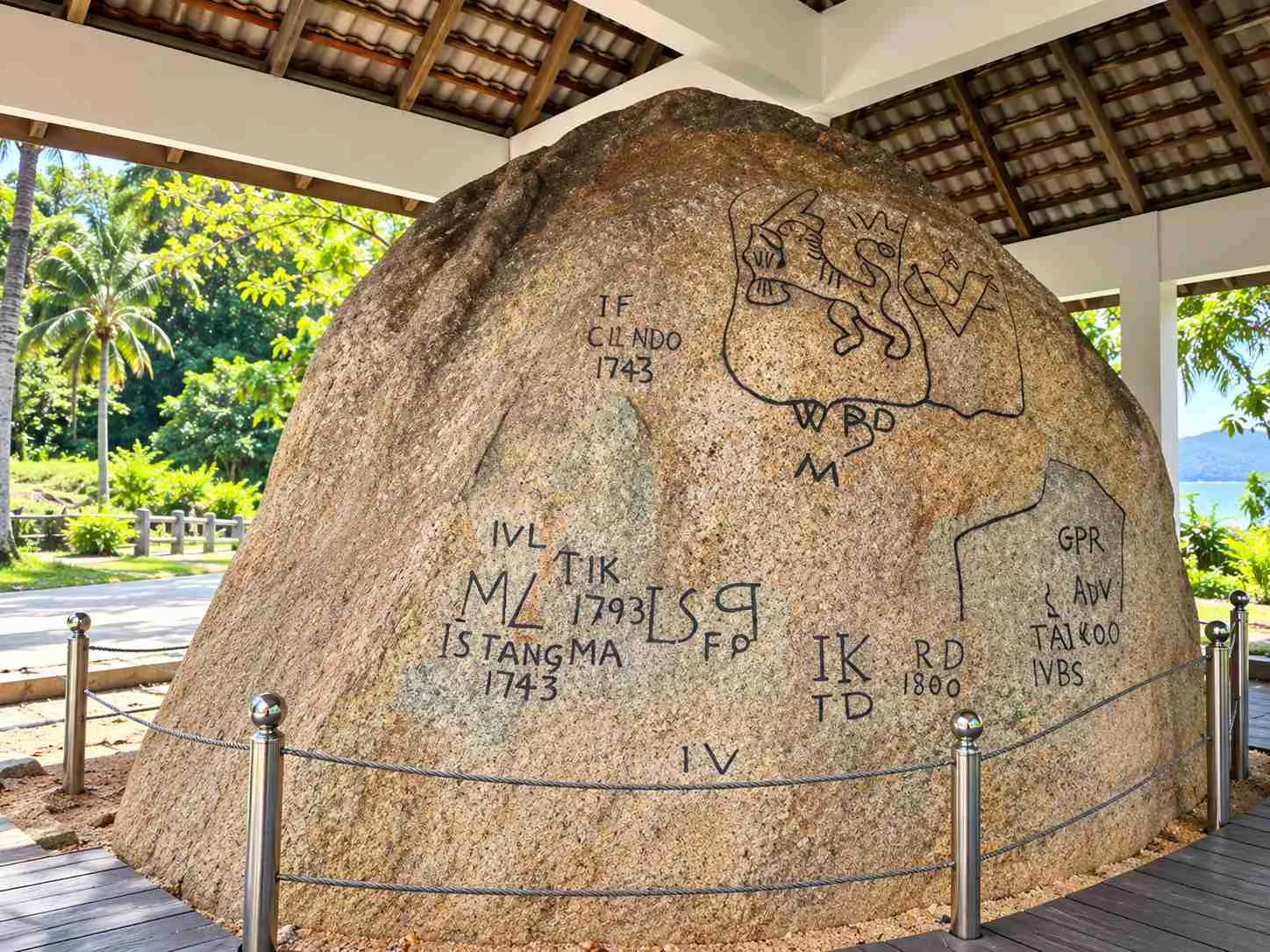
Batu Bersurat Pangkor is a historic inscribed granite rock near Dutch Fort in Teluk Gedung, Pangkor Island. Dating from the period of Dutch activity around 1743, the stone features VOC-related inscriptions and a mysterious animal-and-child carving that has inspired several local stories.
About Batu Bersurat Pangkor
Heritage
Batu Bersurat Pangkor, also known as Batu Bersurat Belanda, the Pangkor Inscribed Stone or informally as Tiger Rock, is one of Pangkor Island's most intriguing historical landmarks. Located in Teluk Gedung close to Dutch Fort, the large granite rock contains carvings and inscriptions associated with the period of Dutch activity on the island during the 18th century.
Among the markings are the year 1743, letters associated with the VOC or Dutch East India Company, other initials, and a distinctive carved image traditionally interpreted as an animal carrying or attacking a child.
The exact meaning behind some of these carvings remains uncertain, which has helped Batu Bersurat become one of Pangkor's most interesting historical mysteries. For travellers interested in history and heritage, the stone is best experienced together with nearby Dutch Fort as part of a wider journey through the historical places and attractions of Pangkor Island.
What Is Batu Bersurat Pangkor?
The Malay term batu bersurat can be understood as an inscribed or written stone. Batu Bersurat Pangkor is a large natural granite rock onto which several markings were carved during the period of Dutch activity around Pangkor Island.
The site is closely connected with nearby Dutch Fort, also known as Kota Belanda. During the 17th and 18th centuries, the Dutch maintained a presence in the Teluk Gedung area as part of their involvement in Perak's valuable tin trade.
Historical records indicate that Dutch personnel were again stationed in this area during the 1740s, and the inscriptions on Batu Bersurat are generally associated with this period.
What Is Carved on Batu Bersurat?
Several different inscriptions and symbols can still be identified on the surface of the rock.
The best-known markings include:
- The year 1743
- The letters VOC
- Other initials and letter combinations believed to be connected with Dutch personnel
- A large animal-like figure
- A smaller human-like figure associated with the animal carving
- Other decorative or symbolic markings
The letters VOC are associated with the Vereenigde Oostindische Compagnie, commonly known in English as the Dutch East India Company.
This connection makes the stone an important physical reminder of the Dutch presence around Pangkor and the wider trading history of Perak.
Why Is It Known as Tiger Rock?
Batu Bersurat is sometimes called Tiger Rock because the most recognisable carving has traditionally been interpreted as showing a tiger carrying or attacking a child.
This interpretation has become closely connected with local stories surrounding the site. However, visitors should be aware that the exact identity of the animal and the original meaning of the carving are not completely certain.
Some interpretations describe the image as a tiger, while other historical discussions have suggested that it may represent another symbolic animal. Because the surviving carving is centuries old and documentary evidence about its exact meaning is limited, the most responsible way to understand it is as a historical image with several interpretations.
The Story of the Dutch Child and the Tiger
One of the best-known stories associated with Batu Bersurat concerns the disappearance of a child connected with a Dutch official.
According to the traditional account, the child disappeared while near the area and was believed to have been taken by a wild animal. The carving on the stone was later interpreted as a memorial showing an animal attacking or carrying the child.
This story has been repeated for generations and is part of the cultural identity surrounding Batu Bersurat. However, it should be treated as a traditional explanation rather than a fully established historical fact.
Other versions of the story give different explanations for the child's disappearance, including accounts involving conflict between the Dutch and local communities. These versions also lack enough historical evidence to be presented as confirmed events.
The uncertainty surrounding the carving is part of what makes Batu Bersurat such an interesting heritage attraction.
What Does VOC Mean on Batu Bersurat?
The letters VOC are associated with the Dutch East India Company, one of the most powerful European trading organisations operating in Asia during the 17th and 18th centuries.
The company was involved in regional trade throughout Southeast Asia, including commercial activities connected with Perak's tin resources.
The appearance of VOC-related markings at Batu Bersurat provides a physical connection between Pangkor Island and this wider period of maritime trade and European commercial expansion.
Why Is the Year 1743 Important?
The year 1743 appears among the best-known inscriptions associated with Batu Bersurat.
This date corresponds with a period when Dutch personnel were again active around Teluk Gedung and the nearby Dutch installation. Historical records indicate that Dutch soldiers were stationed in this area during the 1740s to protect their interests and facilities.
The date therefore helps connect Batu Bersurat with the documented Dutch presence on Pangkor Island rather than treating the stone simply as an unexplained natural landmark.
The Connection Between Batu Bersurat and Dutch Fort
Batu Bersurat and Dutch Fort are closely linked historically and geographically.
The inscribed stone is located only a short distance from Kota Belanda, the Dutch site established at Teluk Gedung. Historical sources place Batu Bersurat approximately 100 metres from the fort area.
For this reason, visitors should consider both attractions as part of the same heritage stop.
Seeing Dutch Fort first can help provide context for the inscriptions on the stone. The fort explains why Dutch personnel were present in Teluk Gedung, while Batu Bersurat provides a more personal and mysterious physical reminder of their time on the island.
Why Is Batu Bersurat Important to Pangkor's History?
Batu Bersurat is valuable because it provides physical evidence connected with an important period in Pangkor Island's history.
The stone helps illustrate several historical themes:
- The Dutch presence on Pangkor Island
- Perak's historical tin trade
- European commercial activity in the Malay Peninsula
- The strategic importance of Teluk Gedung
- The relationship between Dutch personnel and local communities
- The stories and folklore that developed around historical events
Unlike a modern museum display, Batu Bersurat allows visitors to see inscriptions directly on the original natural rock associated with this historical period.
Where Is Batu Bersurat Pangkor?
Batu Bersurat Pangkor is located in Teluk Gedung on Pangkor Island, Perak, close to Dutch Fort.
The site can be reached by road while travelling around the island. Visitors who do not have their own transportation can arrange a Pangkor taxi for a direct journey to the Teluk Gedung area.
If you want to combine Batu Bersurat with Dutch Fort and several other attractions, it can also be included as part of a Pangkor Island sightseeing tour.
What to Look for When Visiting Batu Bersurat
At first glance, Batu Bersurat may appear to be simply a large rock. Knowing what to look for makes the visit much more meaningful.
- The 1743 inscription: Look for the year associated with the period of Dutch presence in the area.
- VOC markings: These letters connect the site with the Dutch East India Company.
- The animal carving: Observe the famous image traditionally interpreted as a tiger.
- The human-like figure: Look closely at the smaller figure associated with the animal.
- Other initials: Several additional carved letters can be seen on the rock.
- The surrounding location: Consider how close the site is to Dutch Fort and the Teluk Gedung coastline.
Because the carvings have been exposed to the environment for centuries, some details may be less obvious depending on lighting and viewing angle.
Tips for Visiting Batu Bersurat Pangkor
- Visit Dutch Fort and Batu Bersurat during the same sightseeing stop.
- Take time to observe the carvings rather than viewing the stone only from a distance.
- Avoid touching, scratching or adding markings to the historic rock.
- Respect any barriers or conservation instructions around the attraction.
- Bring water and sun protection if exploring Teluk Gedung during warm weather.
- Read about the Dutch history of Pangkor before visiting to better understand the inscriptions.
Facilities and access conditions can change, so visitors should follow the latest information and signs available at the site.
Is Batu Bersurat Pangkor Worth Visiting?
Batu Bersurat is particularly worth visiting for travellers who enjoy history, archaeology, heritage sites and unusual local stories.
It may not require a long visit, but its value comes from understanding the historical context behind the carvings.
The attraction is especially suitable for visitors interested in:
- Pangkor Island history
- Dutch heritage in Malaysia
- Historical inscriptions
- Perak's tin-trading history
- Local legends and folklore
- Colonial-era heritage
- Photography and historical landmarks
Because Dutch Fort is located nearby, the two attractions together form one of Pangkor Island's most important heritage areas.
Combine Batu Bersurat with Other Pangkor Attractions
Batu Bersurat works best as part of a wider cultural sightseeing route rather than as a standalone destination.
After exploring Teluk Gedung and Dutch Fort, visitors can continue to mosques, temples, fishing communities, beaches and other landmarks around the island.
See our complete guide to places to visit in Pangkor Island for more attractions that can be combined into your trip.
For convenient transportation between several locations, explore our Pangkor Island tour options. Travellers who prefer individual point-to-point journeys can instead use a Pangkor taxi.
Planning Your Pangkor Island Visit
If Batu Bersurat is part of a larger Pangkor holiday, it is useful to plan your ferry journey, accommodation and island transportation before travelling.
Our Pangkor ferry and travel information explains the main ways to reach the island, while the Pangkor travel guide provides information about getting around, attractions, accommodation, food and other useful travel topics.
Frequently Asked Questions About Batu Bersurat Pangkor
What is Batu Bersurat Pangkor?
Batu Bersurat Pangkor is a large inscribed granite rock in Teluk Gedung, Pangkor Island. Its carvings are associated with the period of Dutch activity on the island during the 18th century.
How old is Batu Bersurat Pangkor?
The stone itself is naturally much older, but the best-known historical carvings are associated with the year 1743, which is inscribed on the rock.
What does VOC mean on Batu Bersurat?
VOC refers to the Dutch East India Company, the major Dutch trading organisation active throughout Asia during this historical period.
Why is Batu Bersurat called Tiger Rock?
It is commonly called Tiger Rock because one of its carvings has traditionally been interpreted as showing a tiger together with a child or human figure. The exact original meaning of the carving remains uncertain.
Did a tiger really take a Dutch child at Batu Bersurat?
A traditional story says that a child connected with a Dutch official disappeared and was believed to have been taken by a wild animal. However, there are several different versions of the story, and there is not enough evidence to treat any one version as confirmed historical fact.
Where is Batu Bersurat Pangkor located?
Batu Bersurat is located in Teluk Gedung on Pangkor Island, Perak, close to Dutch Fort or Kota Belanda.
How far is Batu Bersurat from Dutch Fort?
Historical information from Arkib Negara Malaysia places Batu Bersurat approximately 100 metres from the Dutch Fort area, making the two attractions convenient to visit together.
How can I get to Batu Bersurat?
Visitors can reach Teluk Gedung by road using local transportation on Pangkor Island. You can travel by Pangkor taxi or include the site in a wider island sightseeing tour.
Should I visit Batu Bersurat and Dutch Fort together?
Yes. The two sites are closely connected geographically and historically. Visiting both helps provide a clearer understanding of the Dutch presence on Pangkor Island during the 17th and 18th centuries.
Discover More of Pangkor's History
Batu Bersurat Pangkor is more than an unusual carved rock. Its inscriptions connect Pangkor Island with Dutch trading activity, Perak's tin trade and the wider maritime history of the region.
At the same time, the uncertain meaning of its famous animal carving has allowed stories and legends to develop around the site for generations.
Visit Batu Bersurat together with nearby Dutch Fort for a better understanding of this period in Pangkor's history, then continue exploring our guide to Pangkor Island attractions and places to visit.
Location
Area: Teluk Gedung
Batu Bersurat Pangkor, Teluk Gedung, 32300 Pulau Pangkor, Perak, Malaysia
Open in Google MapsMore places to visit in Pangkor
Combine Batu Bersurat Pangkor with other beaches, heritage sites and local spots around the island.
Need help planning your Pangkor trip?
Tell us where you are staying, your travel date, number of guests and what you need. We will help you with the most relevant Pangkor taxi, island tour, transfer or local service enquiry.